What's your Voice Protocol?
- Voice Protocol
- Culture
An introduction to the Voice Protocol (VPTCL), and why the way we communicate deserves a place of its own.
I. The starting line
As a mute VTuber, I sometimes feel as though I’m working uphill just to reach the starting line.
Before I can think about a good stream, there’s another question to answer: how am I going to communicate? A setup that feels ordinary to me can require an explanation to someone else. A collaboration can mean working out what each person hears, what the audience hears, and whether our different tools can cooperate. Even when everything works, there are assumptions about what a creator who doesn’t speak conventionally can do.
I don’t want to claim every mute creator feels this way. Some people choose their methods for privacy, characterization, experimentation, or simply because they enjoy them. Others don’t get to choose. And some of us have feelings about our own methods that change from day to day.
But I’ve come to believe we’re overlooking something wonderful.
That’s why I’m building Voice Protocol, a place to discover creators through the ways they communicate, document those methods, and tell the stories behind them.
II. The spark
If you’ve spent time around creators who communicate differently, you may have noticed a spark.
A typed response lands at precisely the right moment. A synthesized voice becomes so familiar that you recognize the personality before you recognize the words. A pause creates suspense. A soundboard cue becomes an inside joke. The audience starts to understand not just what someone says, but the rhythm of how they say it.
Not every delay is intentional, and not every technical constraint is charming. Sometimes a broken audio route is just a broken audio route. But sometimes creators make something distinctive out of the tools at hand.
That’s the part I keep returning to: the communication method isn’t always an obstacle sitting between the creator and their performance. Sometimes it helps shape the performance.
VTubing already asks us to think creatively about identity. We build characters, commission models, track movement, design scenes, and choose how we appear to others. Why wouldn’t the way a character communicates also be part of that craft?
There isn’t one right protocol. Some type and synthesize speech. Some use speech-to-text with a synthetic voice, transform a natural voice, communicate through captions, or combine several methods. Some use ordinary speech alongside a carefully designed system of cues. Their reasons differ, and those differences deserve to be understood rather than flattened into a single label.
I want more people to notice this kind of artistry, including people who have never thought to look for it.
III. A place for the craft: introducing the Voice Protocol
The more I thought about it, the more I noticed how much of this knowledge lives in scattered places.
One person figures out an audio-routing problem. Another discovers a better way to handle interruptions. Someone else makes an ingenious collaboration setup or finds an unusual way to express timing and emotion. Their work may appear in a clip, a Discord conversation, a brief FAQ, or a post that’s hard to find again.
Without a place to connect those discoveries, the next person may have to start over.
Even introducing ourselves can become unexpectedly complicated. How much of a creator bio should be spent explaining the technology? How much should a collaborator have to ask before a stream together? And how can a fan understand what makes a performance interesting without needing to learn an entire software stack first?
The problem isn’t that existing VTuber directories are wrong. Most simply weren’t designed to represent communication methods in much detail. Profiles tend to focus on platforms, affiliations, characters, schedules, and popularity. All useful information. But I think there’s another dimension worth showing.
I want someone to be able to find a future oshi because the creator’s craft intrigues them, not only because that creator is already famous. I want technical information to be discoverable without swallowing the space that should belong to someone’s personality.
And as we approach 2027, in a field where people regularly combine motion tracking, animation, real-time audio, and live broadcasting, I think our digital profiles can be more expressive, too.
So what is Voice Protocol? Voice Protocol is a creator-first directory and editorial for VTubers and streamers who communicate beyond their natural voice. It begins with creator profiles and a directory centered on communication. The ambition reaches further: stories about the people behind the methods, practical explanations of how the workflows function, and shared ideas that help the art develop.
It isn’t intended to decide which method is best. It’s a way to give each method, and more importantly each creator, room to be understood.
IV. A message across the stars
When I thought about what Voice Protocol should look and feel like, I kept coming back to an old human impulse: the desire to reach someone who is far away.
The telegraph once made it possible to send words across distances without carrying a human voice along with them. A sequence of signals could cross the wire and become a message someone else understood. The technology imposed a form, but people still found a way to say what they meant.
Then there is Voyager.
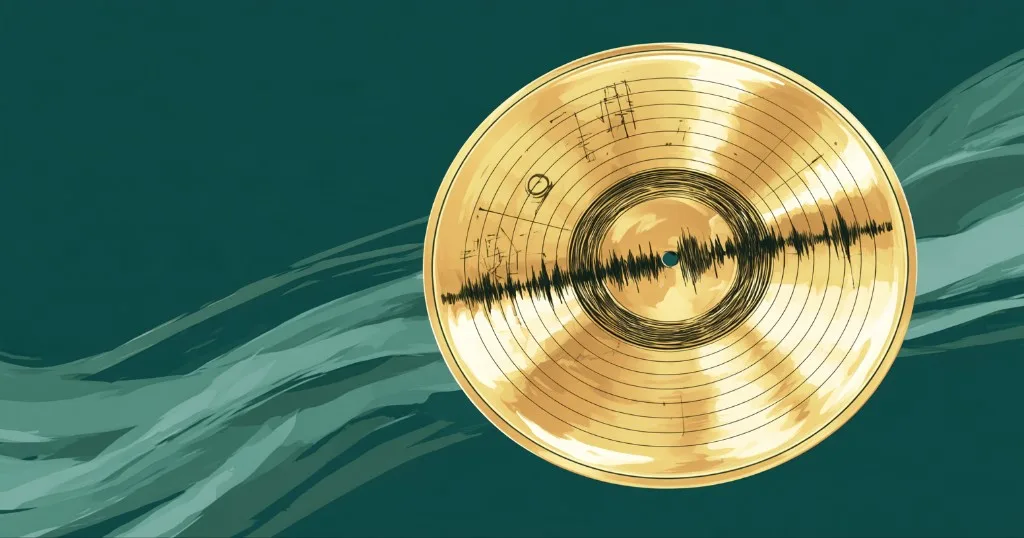
In 1977, the Voyager spacecraft set out carrying the Golden Records: physical messages from Earth, made in the hope that an unknown finder might one day learn something about us. The records contain sounds of nature, music, spoken greetings, and pictures encoded as analog signals. Their covers offer instructions and scientific references intended to help a distant recipient make sense of what they’ve found.
I love the audacity of that gesture. Humanity couldn’t know who, if anyone, would encounter the records. We couldn’t assume a shared language, or even a shared understanding of our technologies. So we assembled different forms of expression and included a way to begin decoding them.
It was an introduction across an almost unimaginable distance.
That idea helped shape the imagery of Voice Protocol: an anime maiden journeying through space, telegraph in hand, Voyager continuing outward, and the golden disc holding a small collection of earthly messages. Each element belongs to a different moment in communication history, but they share an underlying wish.
Here is who we are. Can we reach you?
Of course, a VTuber typing to friends on stream isn’t sending a message to another civilization. The scale is different, and the comparison is symbolic. But I recognize something of that same longing in the technologies we invent, combine, and adapt to make ourselves known.
A voice does not have to begin with vocal cords to carry a personality. A message doesn’t need to travel in a familiar format to mean something to its audience. What matters is the person reaching out, and the possibility that someone else will meet them there.
V. What’s your Voice Protocol?
I want Voice Protocol to become a place where these introductions are easier.
A creator should be able to show who they are and how they communicate without treating either subject as an awkward footnote. A fan should be able to discover someone whose style catches their imagination. And a fellow creator should be able to see a workflow and think: I didn’t know you could do that.
There will be more to learn, and the project should grow by listening to the people who use it. No one should have to turn a limitation into an inspirational story to belong here. Choosing an unusual method can be an artistic decision. Using one out of necessity can be part of a person’s reality. Both deserve room, without anyone having to justify themselves.
Voice Protocol is published by SylphSpeak and operates as an independent editorial. The views of featured creators do not represent SylphSpeak, and SylphSpeak’s views do not represent theirs. Being featured does not mean SylphSpeak sponsors or endorses the creator, or that the creator sponsors or endorses SylphSpeak. Use of SylphSpeak is not required to take part. The point is to document how creators actually communicate, whatever tools they prefer.
This is only a beginning. A directory cannot create a culture by itself. People do that, through their experiments, their jokes, their frustrating troubleshooting sessions, their performances, and the friendships that form along the way.
But a place to find one another, learn from one another, and preserve some of that work seems like a worthwhile beginning.
Whether you’re mute, nonverbal, protecting your privacy or building a character, your method is welcome here, and you never have to explain why.
So whether you type, speak, synthesize, transform, caption, signal, or mix together something entirely your own, I’d love to see what you’ve made.
And if you’re here as a fan, I hope you find someone who surprises you.
What’s your Voice Protocol?
Related posts
- Oct 16, 2026
- Systems
What is a text-to-speech (TTS) VTuber?
- Oct 16, 2026
- People